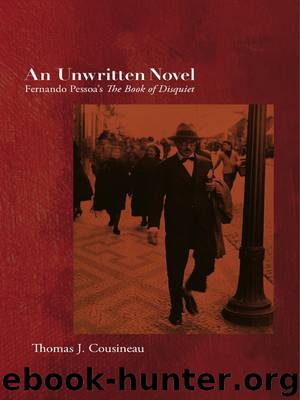
An Unwritten Novel by Thomas Cousineau
Author:Thomas Cousineau
Language: eng
Format: epub
Publisher: Columbia University Press
Published: 2013-03-14T16:00:00+00:00
In my dreams I’ve sometimes tried to be the unique and imposing individual that the Romantics envisaged in themselves, and I always end up laughing out loud at the very idea. The ultimate man exists in the dreams of all ordinary men, and Romanticism is merely the turning inside out of the empire we normally carry around inside us. Nearly all men dream, deep down, of their own mighty imperialism: the subjection of all men, the surrender of all women, the adoration of all peoples and—for the noblest dreamers—of all eras. Few men devoted, like me, to dreaming are lucid enough to laugh at the aesthetic possibility of dreaming of themselves in this way. (53)
Allusions to such dreams of empire occur repeatedly—and often with mordant and liberating irony—throughout The Book. At one point, Soares, reflecting on the fate of the “poor salesmanly demigods who conquer empires with lofty words and intentions but need to scrounge up money for food and the rent,” compares them to “the troops of a disbanded army whose commanders had a glorious dream, which in them—now trudging through the scum of marshes—has been reduced to a vague notion of grandeur, the consciousness of having belonged to an army, and the vacuity of not even knowing what the commander they never saw had ever done” (60).
Soares invokes—as an alternative to this invisible commander—certain spiritual masters from whom one may acquire—rather than envying—the virtues of lucidity and detachment: “I know nothing greater, nor more worthy of the truly great man, than the patient and expressive analysis of the ways in which we don’t know ourselves . . . Flashes of awareness that we live an illusion—that, and no more, is what distinguishes the greatest of men” (133–4). In Text 149, he cites Socrates and Francisco Sanches as masters of irony and in Text 123 similarly praises the Buddha and Christ as exemplary models for the renunciation of so-called reality. Soares likewise pays tribute to “the jaded indifference of the emperor Severus,” who once said “omnia fui, nihil expedit—I’ve been everything, nothing’s worth the trouble” (120). Text 219 adds to the list of these masters of lucidity the names of Plato, Scotus Erigina, Kant, and Hegel.
Underlying Soares’s readiness to submit to the example of these great spiritual masters is the longing for what he calls “paternal hand,” which he attributes, not only to himself, but to humanity in general:
Download
This site does not store any files on its server. We only index and link to content provided by other sites. Please contact the content providers to delete copyright contents if any and email us, we'll remove relevant links or contents immediately.
4 3 2 1: A Novel by Paul Auster(12505)
The handmaid's tale by Margaret Atwood(7832)
Giovanni's Room by James Baldwin(7432)
Asking the Right Questions: A Guide to Critical Thinking by M. Neil Browne & Stuart M. Keeley(5831)
Big Magic: Creative Living Beyond Fear by Elizabeth Gilbert(5827)
Ego Is the Enemy by Ryan Holiday(5523)
The Body: A Guide for Occupants by Bill Bryson(5175)
On Writing A Memoir of the Craft by Stephen King(4996)
Ken Follett - World without end by Ken Follett(4787)
Adulting by Kelly Williams Brown(4621)
Bluets by Maggie Nelson(4602)
Eat That Frog! by Brian Tracy(4593)
Guilty Pleasures by Laurell K Hamilton(4502)
The Poetry of Pablo Neruda by Pablo Neruda(4167)
Alive: The Story of the Andes Survivors by Piers Paul Read(4076)
Fingerprints of the Gods by Graham Hancock(4045)
White Noise - A Novel by Don DeLillo(4044)
The Book of Joy by Dalai Lama(4036)
The Bookshop by Penelope Fitzgerald(3898)
